WVU medical resident’s work highlighted in national publication, expanding interest in kidney research
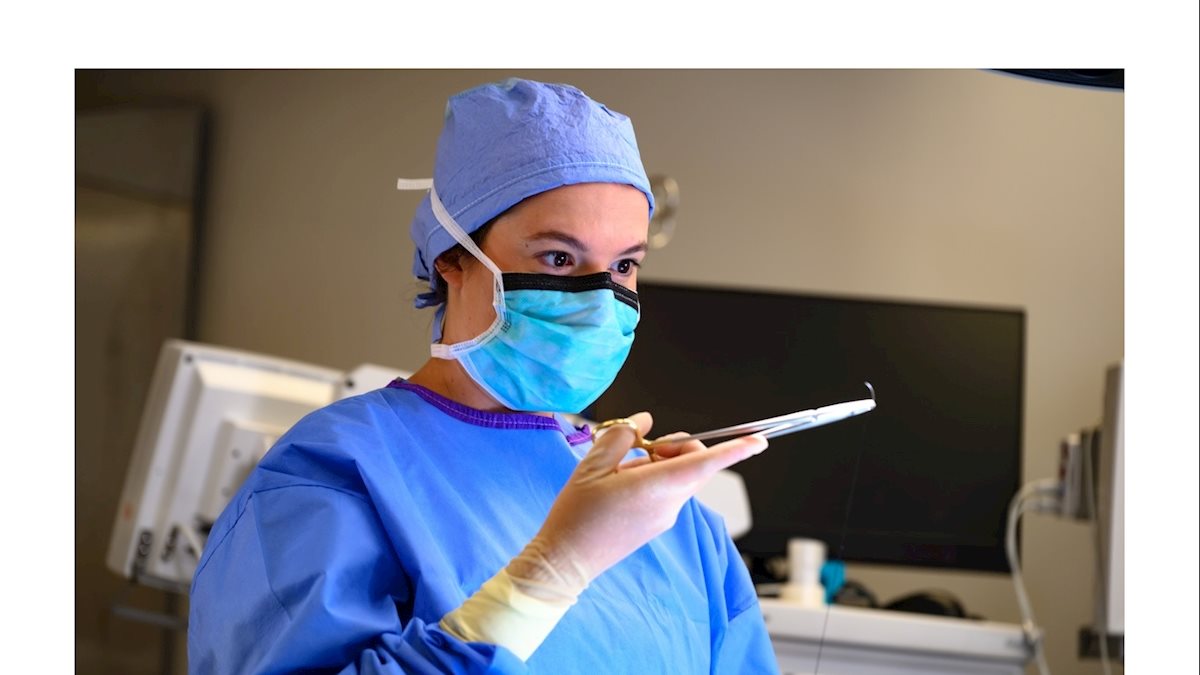
MORGANTOWN, W.Va. — Professionally, Dr. Andrea Pettit might be best known for her published research work in endourology, but that’s not all the West Virginia University School of Medicine graduate has going on alongside her residency at WVU Medicine J.W. Ruby Memorial Hospital. Nor is it all she has in mind to keep fueling her passion for research.
The study, which details the benefits of using aspiration devices in kidney stone surgery, made the cover of AUA News — an uncommon accomplishment for medical residents. The monthly publication is geared toward explaining new urology techniques and how they can fit into providers’ practices.

The work resulted when Pettit was merely exploring research topic options. That’s when she met Dr. Michelle Semins, chief of urology at WVU Medicine Wheeling Hospital, who gave a presentation at the American Urological Association that Pettit found interesting.
“It summarized how the pressure inside of a kidney can matter for outcomes during a lot of surgeries, predominantly stone procedures and how there are new devices on the market that allow us to augment these pressures and either monitor them or lower them,” Pettit said. “It’s one of the things on the forefront of urology to make the surgery safer and more effective”
Semins suggested the topic needed some attention. She and Pettit collaborated on the article that compared data from several studies showing that actively monitoring intrarenal pressure — fluid pressure within the kidney — and utilizing suction devices that reduce that pressure will be a field that continues to evolve in the practice of endourology.
“It’s exciting because with these devices you decrease the rate of bacteremia, SIRS, fever, hemorrhage, all are feared sequelae of ureteroscopy,” Pettit said. “Right now, they show promising evidence. They’ve been rolled out for maybe a year or two. Not only does it help the patient, it is beneficial to the physician as well. Obviously, down the line, if it can prevent an ICU admission or a patient from getting septic, that’s priceless.”
Pettit said her love of research and science developed as an undergraduate at WVU where she earned her degree in immunology and medical microbiology. “I had the best mentors, Dr. Rosana Schafer and Dr. Jennifer Franko, and they’re still my mentors. They gave me confidence to continue my education.”
From there, she obtained a Master of Philosophy degree in primary care research at the University of Cambridge and returned to WVU for medical school.
While urology is still of general interest for Pettit, she’s zeroing in on a more specific area of the field by focusing on oncology, what she sees as her passion in medical care.
“For me, that has slowly been evolving,” she said. “I have slowly become drawn to oncologic patients because they’re facing something that can be scary. As a surgeon, it’s an interesting place to be because you hold a lot of the knowledge, and the best thing is being able to talk with patients using layperson terms.”
One of Pettit’s main mentors during residency has Dr. Ali Hajiran, M.D., associate professor, residency program director, chief of urologic oncology and director of robotic surgery in the School of Medicine Department of Urology.
That’s led to her current research on kidney cancer in patients with underlying kidney disease and a review for variant histologies for kidney cancer. Her forthcoming study will center on oncologic patients in Appalachia.
“I have a vested interest in Appalachian patients and West Virginians specifically,” said Pettit, a native of Morgantown. “That’s where I’m from and you can see firsthand how hard it is sometimes to get care in Appalachia. The shortcomings our patients face, whether they are environmental or social, are unique to this area.”
Her interest in oncology was also inspired by Dr. Steven Campbell, who just completed his first year as chairman and professor in the School of Medicine Department of Urology. A nationally renowned expert in renal cell carcinoma, and bladder and prostate cancer, he has authored more than 400 papers and served as the lead author of the American Urological Association’s Guidelines for the management of kidney cancer.
“Since he came to WVU, the research that I’ve been involved in has changed and it’s been great because of his background,” Pettit said. “He’s able to see the bigger picture. The research he brings to the table is phenomenal. Having someone like that at WVU to help you with research and help you decide on your career has been totally impactful and I’m very thankful for that.”
While residents are encouraged to participate in one research project a year, they may elect to do more. For Pettit, more is “enjoyable.”
“I think the core principle that brings together a lot of people who do research is that you give back to your patients in a very indirect way,” she said. “You know a given patient may never see the fruits of your research. But it's really nice to be able to look at data, generate ideas, and question how we can advance the field and make modern medicine better for our patients and improve outcomes. Aside from benefiting patients directly, it also is nice to think about how you can contribute to the field in a very broad sense.
“I am grateful to both Drs. Hajiran and Campbell for helping me get started with this research and for their mentoring as it has been moving forward.”
-WVU-
ls/9/23/26
MEDIA CONTACT: Linda Skidmore
Health Research Writer
WVU Health Sciences Center
Linda.Skidmore@hsc.wvu.edu