Clinical Education Plan
Master of Science in Athletic Training
Clinical Education Plan
The Master of Science in Athletic Training program offers exceptional patient care experiences, starting early in the curriculum and culminating in three immersive clinical rotations, including one 4-week and two 15-week full-time experiences, along with varied traditional and mini rotations. These hands-on opportunities prepare students to excel as skilled and confident athletic trainers. Individual clinical education plans are uniquely developed for each student to ensure they are optimally prepared to provide the highest level of care that aligns with their future professional and personal goals.
Clinical Rotations
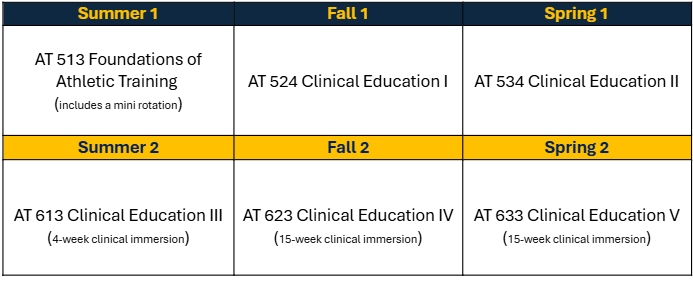
Year 1 - Clinical rotations in the first year of study occur in the local Morgantown area and are completed concurrently with weekly coursework. All students are required to complete the following:
- Mini rotation– Included in AT 513 Foundations of Athletic Training and focuses on interacting with healthcare providers as part of the emergency medical system. Students will complete a mini rotation in the emergency department of the local hospital as well as participate in ride-along shifts with Emergency Medical Services (EMS).
- AT 524 Clinical Education I (3 credits)
This introductory clinical experience focuses on familiarizing students with the athletic training environment and fundamental clinical skills. Students will observe and participate in basic patient care under close supervision, including injury recognition, vital signs assessment, and professional communication. Emphasis is placed on developing ethical behavior, understanding clinical roles, and beginning accurate documentation practices. - AT 534 Clinical Education II (3 credits)
Building on foundational skills, this clinical experience focuses on hands-on injury evaluation and basic therapeutic interventions. Students will actively assist in injury prevention strategies, perform supervised assessments, and participate in rehabilitation plans. The course highlights effective communication within healthcare teams and reinforces ethical decision-making.
Professional Year 2 - Students have the option to complete all immersion rotations at any approved clinical sites across the country. All students are required to complete the following:
- AT 613 Clinical Education III (July – 2 credits)
This intermediate clinical placement allows students to take on greater responsibility in patient assessment and management. The first of three full-time clinical education experiences. This 4-week, full-time clinical immersion rotation provides the athletic training student with the opportunity to engage more fully in patient care. - AT 623 Clinical Education IV (9 credits)
The second of three full-time clinical education experiences. This advanced clinical experience allows students to demonstrate autonomy in managing acute and complex injuries under preceptor supervision. Responsibilities include emergency response, coordination of patient care, and leadership within the clinical setting. Students will apply advanced assessment techniques, execute rehabilitation protocols, and communicate effectively across interdisciplinary teams. - AT 633 Clinical Education V (8 credits)
The third of three full-time clinical education experiences. This capstone clinical experience focuses on consolidating knowledge, skills, and professional behaviors to prepare students for professional practice. Students will function with increased independence, lead patient care activities, and mentor junior students. Emphasis is placed on applying evidence-based practice, ethical standards, and effective communication to complex clinical scenarios.
At the WVU MSAT program, clinical education placements are carefully coordinated by the Director of Clinical Education (DCE) to provide a personalized and enriching experience. Students have the opportunity to share their preferences for clinical sites and work closely with the DCE each semester to tailor their clinical education plan. With varied clinical rotations—including off-campus opportunities—students gain real-world experience, supported by guidance and planning to ensure their success every step of the way. Prior to the start of each clinical rotation, each student will meet with the DCE to discuss transportation needs and ensure a successful placement. If dependable transportation is a challenge, we will work closely with the student to identify a clinical site that aligns with their circumstances while providing a valuable learning experience.