Program Curriculum
The goal of the Urology Residency Training Program is to develop highly skilled, well-rounded urologic surgeons equipped to pursue either an academic or private-practice career. We emphasize excellence in clinical care, a commitment to scientific discovery, and the highest standards of professionalism and integrity. By graduation, each resident will demonstrate competency across core domains including clinical science, practice-based learning, communication, professionalism, and systems-based practice.
Throughout training, residents gain comprehensive knowledge of the etiology and management of urologic disease across all major subspecialties: andrology, infertility, sexual medicine, stone disease, neurourology, obstructive uropathy, urologic oncology (including laparoscopic and robotic techniques), pediatric urology, endourology, ESWL, female pelvic medicine, reconstructive surgery, infectious and renovascular diseases, adrenal surgery, trauma, and urodynamics. Graduates are prepared to deliver complete patient care—beginning with evaluation and diagnosis and extending through treatment selection, surgical management, postoperative care, complication management, preventive counseling, and collaboration within multidisciplinary teams. Responsibility is progressively increased at each level of training to ensure readiness for independent practice.
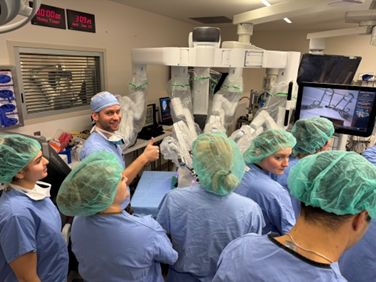
The PGY-1 year includes six months of general surgery—covering colon and rectal surgery, plastic and reconstructive surgery, surgical critical care, surgical oncology, and trauma—and six months of urology. PGY-2 residents focus on general urology, pediatric urology, and an introduction to robotic surgery. PGY-3 emphasizes endourology and minimally invasive surgery, with exposure to more advanced pediatric cases. PGY-4 builds on advanced endourology and minimally invasive techniques while introducing complex urologic oncology and additional high-level pediatric experience. During the PGY-5 year, residents serve as chief, concentrating on urologic oncology, reconstructive surgery, and advanced robotic procedures across all subspecialties.
For more detailed information about each year’s curriculum, please refer to the Urology Resident Manual